AMH normal range: understanding your ovarian reserve test
AMH (anti-Mullerian hormone) is a hormone made by small follicles in the ovaries, which hold the eggs. The AMH level gives a rough idea of how many eggs are left, called the ovarian reserve. It is naturally higher in younger women and slowly falls with age, becoming very low after menopause. Women often get it checked when planning a pregnancy, before fertility treatment, for irregular periods or suspected PCOS. AMH is not a test of fertility on its own; many women with low AMH still conceive.
Low for ageLower egg reserve; not infertility on its own
Below about 1.0 ng/mL
Very lowDiscuss with a gynaecologist
Below about 0.5 ng/mL
HighOften seen in PCOS
Above about 4 – 5 ng/mL
After menopauseExpected
Very low or not detectable
Ranges differ a little from lab to lab.
What does my result mean?
AMH AMH 0.5 ng/mL
This is low and suggests a lower egg reserve. It does not mean you cannot get pregnant; a gynaecologist will explain what it means for your plans.
AMH AMH 1.0 ng/mL
This is around the lower side of the typical range. Its meaning depends a lot on your age, so discuss it with your gynaecologist.
AMH AMH 6 ng/mL
This is higher than typical. It is often seen in PCOS, but a gynaecologist will look at your periods, ultrasound and other tests before saying anything.
What this test checks
The test measures AMH in the blood in ng/mL (some labs use pmol/L). It does not tell egg quality or whether you can get pregnant right now. It is advised for women planning pregnancy later, those with trouble conceiving, before IVF, and sometimes in PCOS. A gynaecologist reads it together with your age, ultrasound and other hormone tests and advises if repeat testing is needed.
Common reasons for a high value
PCOS (polycystic ovary syndrome)
Younger age, when egg reserve is naturally higher
Rarely, certain ovarian growths that a doctor needs to check
Common reasons for a low value
Increasing age, which is natural
Earlier ovarian surgery, chemotherapy or radiation
Endometriosis affecting the ovaries
Approaching menopause
Smoking
Some hormonal birth control pills can lower it for a while
How to prepare
AMH can be tested on any day of your period cycle and does not need fasting. Tell your doctor if you take birth control pills or hormone treatment, or if you are pregnant, as these can affect the result.
When to see a doctor
See a gynaecologist to understand your AMH result, especially if you are planning a pregnancy, have been trying for a year (or six months if over 35), or have irregular periods. AMH alone should not be used to make decisions about fertility; your doctor will look at the full picture.
AMH – FAQs
What is a normal AMH level?
For women in their 20s and 30s, AMH is often about 1.0–3.5 ng/mL, and it falls with age. There is no single normal value for everyone. The range printed on your own report applies, and a gynaecologist interprets it.
Can I get pregnant with low AMH?
Yes, many women with low AMH conceive naturally. AMH shows the number of eggs left, not their quality. A gynaecologist will guide you based on your age and other tests.
Is high AMH a sign of PCOS?
High AMH is often seen in PCOS because there are more small follicles in the ovaries. But PCOS is diagnosed by a doctor using symptoms, ultrasound and other tests, not AMH alone.
Can I get an AMH test at home?
Yes. It can be done on any day of your cycle without fasting. A trained person collects the sample at your home, it is tested at a partner lab, and the report comes on WhatsApp and email.
This page is general information, not medical advice. The normal range printed on your own report is the one that applies, and only a doctor can tell what your result means for you.
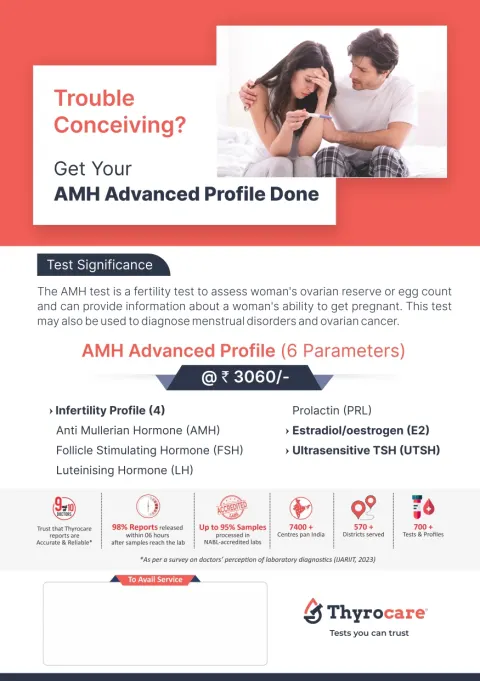
Anti-Müllerian Hormone (AMH) Advanced profile includes 6 crucial hormones like AMH, LH, FSH, estrogen, UTSH and Prolactin in women for their reproductive system functioning. AMH is a marker used to evaluate an ovarian reserve and predict the outcome of In-vitro Fertilization (IVF). This profile helps understand menstrual health, infertility issues or other reproductive health issues. It can also helps assess the ovarian function in patients with PCOS, diagnose and monitor ovarian tumors and determine the menopausal status.